Why Do Sea Otters Hold Hands?

A defensive social strategy and other sleeping behaviours in the animal kingdom that successfully illustrate evolution in action.
If you’ve been an internet user in the past five years, I can almost guarantee that you’ve seen a picture of sea otters adorably holding hands while floating on their backs. Although very cute, like most animal behaviour this seemingly innocent gesture has an adaptive origin - helping the otters in some biologically meaningful way.
It is widely thought that otters carry out this behaviour to avoid losing each other while getting some well-earnt shut-eye. By holding hands (or paws), they avoid drifting away from each other. When otters group together in this way, the behaviour is known as ‘rafting’.
When couples carry out this behaviour, notably during breeding seasons, it is thought to serve a secondary purpose. Males grab hold of their mates to prevent them from re-mating with other males while they are unconscious. This is a beneficial evolutionary strategy for the males, as it assures the paternity of their offspring.
To understand how social behaviour arises, let's break down this concept. This behaviour was transmitted over generations, as those who used it were more successful in fathering children. Conversely, males who didn’t guard their mates, risked females remating and conceiving offspring with other (what biologists call ‘sneaky’) males. Hence, male sea-otters that started ‘guarding’ their females (by holding their hands), fathered more offspring and ensured their genes were passed on. These genetic offspring will reprise the behaviour, causing it to spread in coming generations as a successful strategy that ensures reproduction. Eventually, the bulk of the population will comprise of individuals exhibiting the strategy - and it becomes a fixed behaviour for the species.
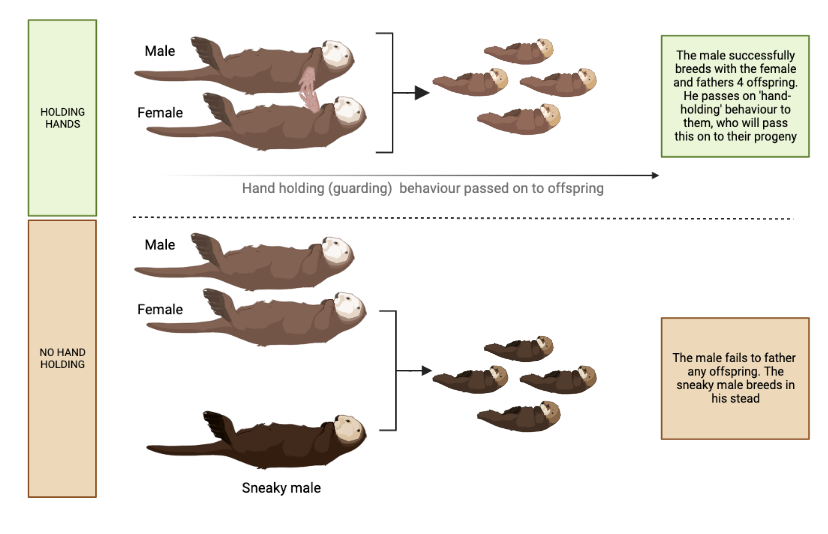
Representation of the success of hand-holding behaviour in securing paternity for the male. Created on Biorender by Hannah Dodd-Vastiau.
However, as with many behaviours, it’s not explicitly clear whether it has a genetic origin or may have spread as a socially-learnt behaviour – akin to a trend.
Finally, rafting is thought to be a defensive behaviour to prevent sea otters from floating too close to the shore as well as granting them safety in numbers from predators. Although necessary, sleeping is the most vulnerable state an animal can put themselves in, as a result, many animals have developed sleeping habits with a defensive basis.
Penguins and giraffes are known to powernap intermittently to stay alert to predators and conserve energy. Long-flight birds have been shown to sleep during flights, with the wandering albatross catching an average of 42 minutes of sleep a day. Dolphins sleep with half their brain at a time to still be able to perceive predators and alternate which side is unconscious to rest their mind fully.
You may be wondering why all animals don’t have odd sleeping habits. It all depends on an animal's ecology, the environment, and the predators the species historically interacts with. Some come up with other strategies or simply don’t need to develop any. Sloths are well-known sleepy creatures that are unconscious for a whopping 12 to 15 hours a day. However, as able climbers, they can fall asleep hanging from unreachable branches. With no flying or climbing predators, this ability is enough to keep them from danger and enables them to sleep uninterrupted for many hours – something they so clearly take advantage of.
Traits and behaviour develop over evolutionary time and are shaped by species' specific environmental pressures and ecology - evolution in action.

John Warden/The Image Bank/Getty Images


So interesting! I knew it was about hanging on to a mate but never thought of it in terms of assuring paternity. Looking forward to the next one!